Cat lion cut: what it is, what it costs, how long it lasts
Short body, full mane, boots and a tail pom. Why the blade matters on thin cat skin, when it should be a vet visit, and how long the coat takes to come back.

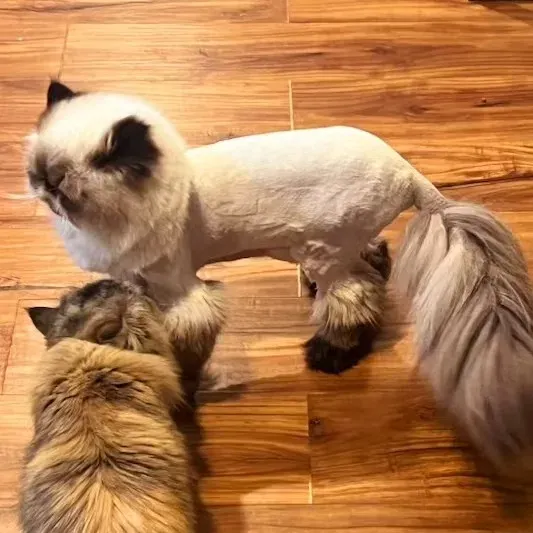
A cat lion cut clips the body, belly and chest short and leaves the head, the lower legs and a pom on the end of the tail full, so the cat looks like a small lion. Groomers do it mostly for matting. It's rarely a style choice. At Barky Mountain in Lone Tree, a lion cut or heavy de-matting starts at $115.
A lion cut is one of four ways a groomer can shorten a cat's coat. The other three take less off.
| Option | What gets clipped | Hair left | When it's used |
|---|---|---|---|
| Lion cut | Body, belly and chest | About 1/16 inch (#10 blade) | Mats or pelts across the body, or a cat who can't keep up with a long coat |
| Comb cut | The whole body, through a comb attachment | 3/8 to 1 inch | A long coat with no mats that the owner wants shorter |
| Belly shave | Underside only | Short | Mats that start in the armpits and belly |
| Sanitary trim | Inside the back legs, lower belly, under the tail | Short | Litter or mess caught in the back end |
What a cat lion cut looks like
The body is clipped close. Boots are left on the legs, with the lines at the bend of the front elbow and just above the back ankle. The tail is clipped most of the way down and finished with a pom at the tip. The face and head are left alone or tidied with scissors.
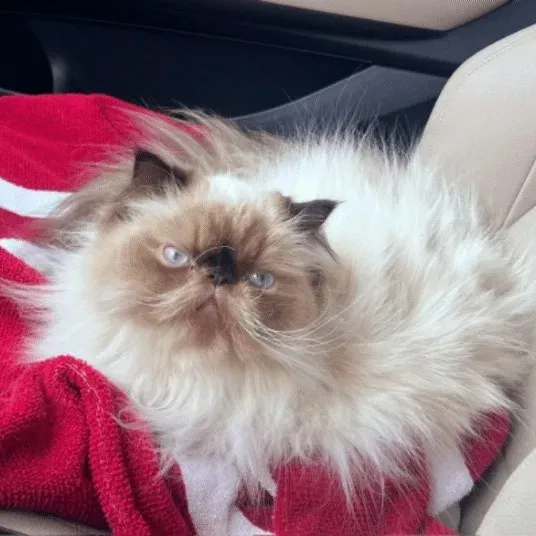
The head follows the breed. Groomers usually leave a full mane around the neck and chest on cats that grow one, like a Maine Coon lion cut or a Norwegian Forest cat. Flat-faced cats are usually given a round head instead, so a Persian or Himalayan lion cut looks more like a ball with a face in it. The Himalayan in our photo has a round head and a full tail plume. Ragdolls can wear either.
Why groomers use a #10 blade on cats
Cat skin is thin and stretchy, and it moves with the clipper. The National Cat Groomers Institute recommends a sharp #10 blade, which leaves about 1/16 inch, even on a cat whose coat has matted into one sheet. It advises against the shorter #30 and #40 blades, because they raise the risk of cutting the skin open. The groomer holds the skin flat and taut and never clips over a fold.
Even then, Dr. Bruce Kornreich of Cornell's Feline Health Center has said that clipping out advanced mats often damages the skin. That's why the job goes slowly, and why nobody should try it with scissors. VCA says to use clippers only, because a mat sits so close to the skin that scissors cut the cat.
Good reasons for a lion cut, and bad ones
Good reasons:
- Mats or a pelt across the body. A pelt is mats joined into one stiff sheet, and it can't be brushed out. When a matted cat needs a shave down covers how to tell.
- An older, arthritic or heavy cat who can't reach her back or hindquarters any more. VCA lists both as cats who need help.
- A long-haired cat who gets mats faster than you can brush them out, even with daily brushing.
Keeping her cool is a bad reason. PetMD, the ASPCA and VCA all say a cat's coat helps her handle heat, and that most cats get through summer without a haircut. Shedding is another one: a lion cut shortens the hairs, but the same number still come out.
Some cats shouldn't get one at all. Heart disease and cancer can make clipping a bad idea, so check with your vet first if your cat has either. And if your cat hid, hissed or went off her food after her last lion cut, tell the groomer, because she may do better with a belly shave or a comb cut.
Groomer or vet?
A groomer can lion cut a cat who can be handled awake. A vet should do it when the cat needs sedation, either because she's too stressed to hold or because the pelt is so bad it would take too long awake. International Cat Care says severe mats often have to come off at the clinic under sedation or anaesthetic.
We don't sedate cats at Barky Mountain. Cats come in during quiet, low-traffic times, and one who does better away from the noise goes into our private room. If we find sores under a pelt, or a cat is too distressed to keep going, we stop and tell you, and the rest is a vet appointment.
How long does a lion cut last?
A short-haired cat usually looks covered again in 2 to 3 months, and a long-haired cat in 4 to 6. The fur starts coming back within a few weeks, and older cats grow it slower. That's how long until she looks like herself. Groomer to Groomer magazine notes that some long-haired cats take 18 to 24 months to get their full length and thickness back.
Pointed cats can grow back darker. Himalayans, Ragdolls, Siamese and other colorpoint cats carry a gene that makes hair darker on cooler skin, and clipped skin runs cooler while the coat regrows. National Geographic quotes a cats-only vet saying the patch usually fades lighter again with time.
To keep her out of a second lion cut, brush a long coat daily once it grows back, which International Cat Care says prevents matting, or book a regular groom before mats start.
Sun and cold after a lion cut
A clipped cat burns more easily, especially a white or light-colored one. In Colorado that counts for more. The EPA puts the rise in UV at about 2% for every 1,000 feet of elevation, which makes it roughly 10% stronger in the Denver area than at sea level. PetMD warns that shaved cats who lie in sunny windows have a higher risk of sunburn, so pull a blind over her favorite spot for the first few weeks. VCA says an outdoor cat should keep at least an inch of coat, which rules a lion cut out for one.
She may act a little aloof for a day after the groom. Watch for licking at one spot, since a small clipper nick or irritation can take a few days to show.
What to tell your groomer
- Where the mats are, and whether your vet has seen any sores under them.
- Mane or round head, boots on or off, and a pom or a full tail.
- Heart disease, cancer, any skin problem, and any medication she takes.
- How she handled her last groom, good or bad.
- If she has no mats and you only want her shorter, ask for a comb cut instead.
At Barky Mountain in Lone Tree, a lion cut or heavy de-matting starts at $115, a long-haired full groom at $90, and a short-haired bath and tidy at $65. Matting and how your cat handles the visit affect the final price, and we tell you before we start. Read what to expect at a cat groom, see our cat grooming page, or book a visit.
Common questions
How much does a lion cut cost?
At Barky Mountain in Lone Tree, a lion cut starts at $115, and heavy matting or a stressed cat can raise it. Prices published by other groomers run from about $65 to over $120.
How long does a lion cut last on a cat?
A short-haired cat usually looks covered again in 2 to 3 months, and a long-haired cat in 4 to 6. Some long-haired cats take much longer to get back to full thickness.
Do vets do lion cuts for cats?
Yes, usually when a cat needs sedation for a severe pelt or can't be handled awake. A groomer does it for a cat who can be handled calmly.
Are lion cuts good for cats?
For a matted cat, or one who can no longer keep her coat clean, yes. For cooling or shedding, no. Vets say the coat helps a cat handle heat, and a lion cut doesn't reduce how much hair she sheds.
What is the difference between a teddy bear cut and a lion cut on a cat?
A teddy bear cut, also called a comb cut or plush trim, leaves 3/8 to 1 inch all over and only works on a coat with no mats. A lion cut clips the body to about 1/16 inch and is the usual fix for a matted cat.