
When a matted cat needs a shave down, and why brushing it out is not kinder
Owners often ask us to brush the mats out instead of clipping, because clipping sounds drastic. On a badly matted cat it is the other way round.

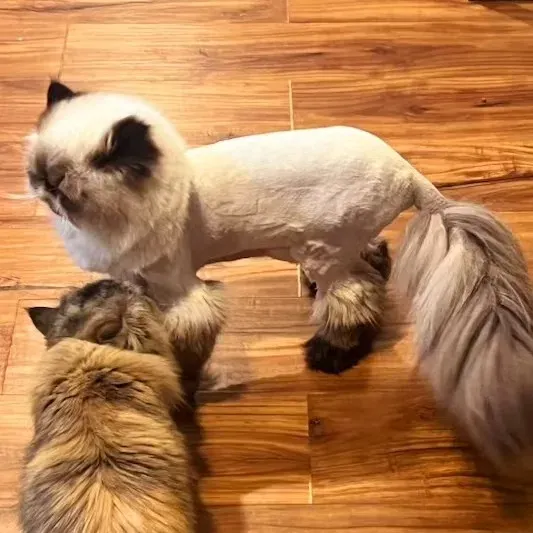
A matted cat is not a grooming problem that got out of hand. It is usually a sign something changed: an older cat who stopped being able to twist around and groom her back, a heavy cat who cannot reach her hindquarters, an arthritic cat for whom the effort hurts, or a long haired cat who was managing fine until she was not. Persians, Maine Coons, ragdolls, and Himalayans end up here most, though any long coat can.
How to tell how bad it is
Run your fingers through the coat down to the skin, particularly on the belly, behind the front legs, under the chin, and along the back end. A few loose tangles that separate under your fingers are ordinary. If you meet a dense mat that moves as one piece with the skin, that is a different thing. If the mats have joined into a single sheet you cannot get a finger under, the coat is pelted, and it is genuinely painful.
Pelting pulls constantly. It traps moisture and dirt against the skin, and the skin underneath is frequently raw, inflamed, or infected by the time we see it. Cats are good at hiding that.
Why brushing it out is not the gentler option
This is the part owners find counterintuitive. Clipping sounds severe and brushing sounds gentle, so people ask us to brush. On a lightly tangled cat, absolutely. On a pelted one, brushing means dragging a comb through hair that is welded to inflamed skin, over and over, for an hour or more, while the cat gets progressively more frightened and more sore. It is not kinder. It is the same pain stretched out much longer, and it usually ends with a stressed cat and a coat that still needs clipping.
Clippers go under the mat and separate it from the skin. A pelted cat is often visibly relieved within minutes.
What a shave down involves
Most matted cats get some version of a lion cut: the body clipped short with the head, the lower legs, and the tail tip left full. It is not cosmetic, or not only cosmetic. Leaving the head and feet gives the cat something that still feels like her own coat, and clipping the body removes the part that is actually causing trouble.
The work is slow and careful because the skin underneath a pelt is thin, loose, and already unhappy, and there is no rushing it safely. Sometimes we find sores that need a vet before anything else happens, and if so we stop and tell you.
Why most groomers will not take your cat
Cats are not small dogs, and handling one badly is how people and cats both get hurt. A lot of salons made a reasonable business decision and stopped accepting them, which is why owners in the south metro often ring five places before finding one that says yes. We say yes, and we have groomers who specialise in it rather than tolerate it.
Keeping her out of this next time
Short sessions beat long ones. A few minutes of combing several times a week, with a steel comb rather than a slicker brush, will catch the beginning of a mat while it still combs out. Pay attention to the armpits and the back end, since those go first. And if your cat has recently stopped grooming herself, treat that as worth mentioning to your vet, because it is often the first visible sign of pain or illness rather than laziness.
If you are already past the brushing stage, that is fine, and it is what we are for. Read more about cat grooming here, or book a visit at our Lone Tree salon. We see cats from Highlands Ranch, Parker, Centennial, Littleton, Castle Pines, Castle Rock, and south Aurora.
Common questions
What is a lion cut for cats?
The body is clipped short, usually to somewhere between an eighth and a quarter of an inch, while the mane around the head and neck, a plume on the end of the tail, and boots on the legs are left full. The face is not touched.
How do you tell if a cat is matted or pelted?
Run your fingers through the coat down to the skin, especially on the belly, behind the front legs, under the chin, and along the back end. Tangles that separate under your fingers are ordinary. A dense mat that moves as one piece with the skin is not, and if the mats have joined into a sheet you cannot get a finger under, the coat is pelted.
Does a lion cut stop a cat from shedding?
No. It shortens the hair that sheds so it is less noticeable, but the same number of hairs still come out. It does not help cat allergies either, since the trigger is a protein in saliva and dander rather than coat length.
How long does it take for a cat’s coat to grow back after a shave down?
About three to six months to full length. Some cats, mostly older ones, come back with a slightly different texture that settles over a cycle or two.
Do groomers sedate cats?
We do not, and no reputable groomer does. If a cat is too severely pelted or too distressed to be groomed awake, that is a veterinary appointment and we will tell you so rather than push through it.